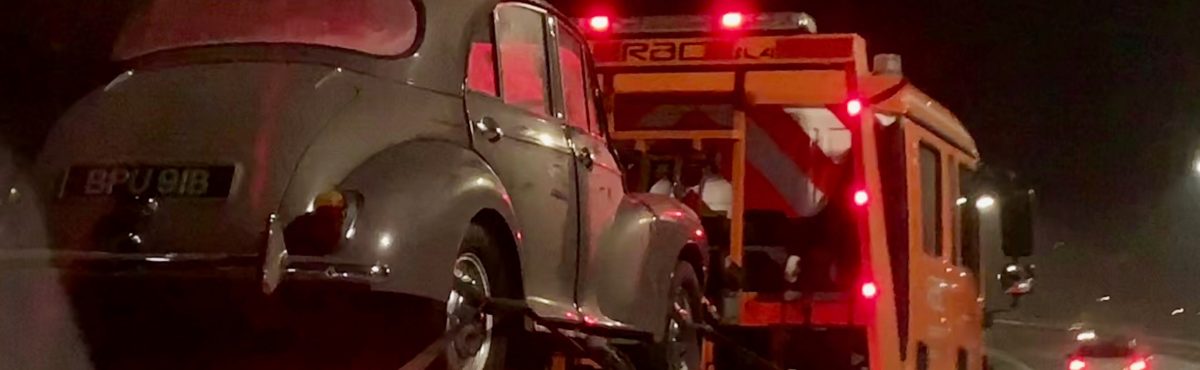
When I got my car I was lucky in that it was accompanied by a lot of paperwork, but I wanted to know more about who owned it, and where it had lived, so in 2022 I applied to obtain a Heritage Certificate from the British Motor Museum, who preserve records from a number of British car manufacturers.
Aside from the obvious information such as car make/model and year of first registration which you will already have on your V5 document, heritage certificates tend to list information such as original chassis number, engine number, original paint colour, specs of factory fitted equipment, and depending on the detail of the records kept may contain other interesting information or parts numbers. Of particular interest to me was the date of manufacture, as I suspect my car to be a 1963 build rather than 1964, when it was registered.
Unfortunately the response I received from the museum’s archivist was that the factory records for my vehicle had not survived. I was a little disappointed by this, so since then I have endeavoured to find out what I could by other means.
What did I already know?
To start at the very beginning, being a Morris 1000 saloon means it came from the Cowley plant on the outskirts of Oxford. (Today a portion of the site continues to produce the BMW Mini)
Cowley was the home of Morris Motors from 1913, and by 1964 the plant had a 12,000-strong workforce and boasted 250 strikes a year.
I knew the date of first registration, as detailed on the V5 document: 22/01/1964
I also knew roughly where my car was first registered, as signified by the letters PU in the number plate, which represent Chelmsford, the county town of Essex. All cars registered in Essex at the time would have had this regional identifier, so I still wanted to narrow this down further.
The breakthrough and the documents
This was actually the last piece of information I obtained, but chronologically it’s the earliest information available about the car, so we’ll start with that; Following the advice of another member of the Morris Minor Owners Club young members branch, I contacted the Essex record office, and was (for a fee) able to get a certified copy of a ledger from 1964 showing who the car was purchased by, their address, the chassis number, and who the sales agent was.
This revealed that first owner was a D W.F Cobbett of Brentwood, and that the car was purchased from a local garage called Savages, less than a 5 minute walk away from their home address.

This is where my car was originally purchased. Unfortunately the building was demolished and the site is now home to a number of flats.
I was lucky enough that my car came with quite a lot of paperwork. I looked through all of the historic documentation and then filed it in chronological order, entered the information I had available to me on each document into a spreadsheet, and worked out where the car had undergone MOT tests, services and repairs, to track where it had moved around. This gave me a base to work from, and gaps in the timeline to fill. The V5 document tells me how many previous owners the car had, and I was able to match up the more significant changes of location with when the car most likely changed hands.
I also used the MOT records to construct a graph showing how much use the car got over time. Exciting stuff!

As the car stayed in southern Essex until the 1990s I then contacted a few Facebook groups dedicated to local history in the areas that cropped up in my research, and several people were able to identify the locations of these garages and provide further information.
The earliest original document I have is from Shenfield Park Garage in 1970, only half a mile away from where the car was bought. This certificate is likely to have been for it’s first MOT. At the time the MOT test wasn’t very thorough at all, and when introduced for the first time in 1960 as a voluntary measure it only examined brakes, lights, and steering, as represented by the three triangles in the MOT logo. In 1968 a tyre check was introduced.

MOTs and old garages
I had only enquired where the garage was on one of the groups, however, with only 5002 miles on the Odometer at the time, it was passed by the mechanic Harold Nightingale, who I was informed by a Shenfield local was an umpire at Hutton cricket club.
Shenfield Park Garage was located next to the recently demolished Eagle and Child pub on the A1023, which was the main road in the area prior to the Brentwood Bypass. No photo seems to exist of the garage and the site is now being redeveloped for housing.
Somewhat oddly the next year’s MOT test was done at Fore Street Garage in Morchard Bishop, Devon; This time with 11,177 miles on the clock. This garage went out of business years ago, and by some accounts as early as the 1980s, but the building survived until around 2009, when it was demolished to make way for houses.

I can only imagine that this MOT in Devon was done whilst on a holiday. From 1972 ’til 1976 the MOT was carried out by Hammond Motors LTD, Frinton-on-Sea, back in Essex.
On the 1975 and ’76 service documents the owner is noted as Miss Cobbett. Before I obtained the record from the Essex records office this was the earliest mention of an owner in my documents, although I now know that she was the first owner.

Unfortunately this garage was demolished in the mid 1980s and the site is now home to residential flats.


As you can see from these photos, Hammond’s garage was an extensive site that at one time offered almost everything the early motorist could require, including secure indoor car parking for visitors to the seaside town, servicing and repairs, and fuel pumped at the roadside. As seems to be a common theme with these old garages, this place too has been demolished and is now home to housing, in the form of Hammond Court flats.
In 1977 and 1978 the MOT was carried out at Maldon Road Garage in Colchester (which as of 2024 still survives in it’s original location at Number 84), and then up till 1986 the car underwent regular MOTs every year at Vernon Haddock Cars of Ardleigh, less than 5 miles away from Maldon Road.

1987 is the next mention of a different owner on the paperwork, where a Mr Perry is referenced, and at this time the car’s MOT shows a move west of Chelmsford, to Stanway, first at Alford Garage, then Barrons service station in 1988, The Stratford garage in Stratford St. Mary for 1989 and 1990, back to Barrons in 1991 where Mrs Perry is on the documents, and finally the car is tested at Mile End Garage in Nayland Road, Colchester in 1992 where Mr Perry is once again mentioned.


No documents seem to exist from 1993 or 1994, but whilst I was researching the car’s origins I was contacted by a family history researcher, who told me he believed the car may have belonged to Stanley William Perry and Lilian Perry of nearby Fordham Heath. Lilian died in April 1992, which explains the car being off the road for the next couple of years.
The car pops up again in 1995 and 1996 at Brian Holmes Auto Repairs, in Ramsey, Essex, and in 1997 was MOT’d at Park Row Garage, Greenwich, London, quite literally in the shadow of Greenwich Power Station, the emergency power source for the London Underground and parts of the National Grid.

In 1989 the car appears to have been in Shadoxhurst, Kent, and then in 1999 at the old British Railway works in Ashford. It’s stay in Kent was brief however.

In 2000 the car was acquired by Caroline Hall of St Albans, who owned the car right up to September 2015. Of all the previous owners she probably did the most to keep the car on the road, and kept documentation for all spare parts, services, MOTs and repairs made to the vehicle throughout that time.
Conclusion: what did I learn from this?
Nothing groundbreaking.
Did I find out the build-date of my car in the end? Unfortunately not – but it is almost certainly a ‘63 car.
Is there any use to knowing the backstory behind your car? No, unless your car is somehow unique or of special historical note, in most cases almost certainly not. There is however some level of satisfaction in solving the puzzle, filling in the blanks and working out what you can from limited information.
 morrisminor.uk